Disclaimer:
The information on this website is for general guidance only. Plant suitability varies by region, soil type, and microclimate. Consult your local native plant nursery for recommendations specific to your area.
Key Takeaways
- Native plants are adapted to local conditions and typically require less water, fertiliser, and maintenance once established.
- Native gardens attract and support native birds, insects, and lizards, contributing to biodiversity.
- Choosing plants that naturally occur in your region gives the best results with least effort.
- A well-designed native garden can be as visually striking as any traditional garden style.
- Eco-sourced plants from local nurseries establish more successfully than generic stock.
A native garden is not about recreating the bush; it is about working with plants that have evolved over millions of years to thrive in exactly your conditions.
There is a persistent misconception that native gardens are somehow less attractive than traditional landscaping, that choosing native plants means settling for a wild, unkempt look. Nothing could be further from the truth. Native New Zealand plants offer extraordinary diversity of form, texture, and colour, and modern native garden design has come a long way from the untamed bush plantings of previous decades.
The practical advantages of native landscaping are compelling. These plants have adapted over millions of years to New Zealand's soils, rainfall patterns, and climate variations. Once established, they typically need no fertiliser, minimal watering, and far less intervention than exotic species struggling to cope with conditions they were never designed for.
Why Native Plants Make Sense
When you plant a rose bred in England or a hedge species from the Mediterranean, you are asking that plant to survive in an environment fundamentally different from its homeland. It may succeed, but it will likely need ongoing support: regular watering during dry spells, fertiliser to compensate for unfamiliar soils, and interventions to combat pests and diseases it never evolved to resist.
Native plants face none of these challenges. A kowhai planted in Auckland is growing in conditions its ancestors thrived in for thousands of years. The soil microorganisms, the rainfall patterns, the temperature ranges, everything is familiar. This is why established native gardens often seem to look after themselves.
Benefits of Native Landscaping:
- Water efficiency: Native plants are adapted to local rainfall and typically need no irrigation once established.
- Low maintenance: No fertiliser required; natural pest resistance reduces spraying.
- Wildlife support: Native birds, bees, and insects depend on native plants for food and habitat.
- Year-round interest: Different species flower across seasons, providing continuous colour.
- Climate resilience: Better adapted to cope with weather extremes and changing conditions.
Choosing the Right Plants for Your Garden
New Zealand has remarkable plant diversity, with different species naturally occurring in different regions, altitudes, and microclimates. A plant that thrives in coastal Northland may struggle in frosty Canterbury, even though both are native New Zealand species.
The concept of "eco-sourcing" means using plants grown from seeds or cuttings collected in your local area. These plants carry genetic adaptations to your specific conditions and establish more reliably than generic nursery stock grown from seed collected elsewhere.
Start by visiting a native plant nursery that specialises in locally sourced stock. The staff can advise which species suit your conditions, including challenging situations like coastal salt spray, heavy clay soils, deep shade, or frost-prone hollows.
Popular Native Plants by Use:
- Screening and hedging: Griselinia, corokia, pittosporum, lacebark. These dense-growing species create effective privacy screens.
- Specimen trees: Kowhai, pohutukawa, puriri, totara. Striking focal points with seasonal flowers or distinctive form.
- Ground covers: Native grasses, native sedges, coprosma groundcovers, native violets. Excellent for suppressing weeds and filling spaces.
- Coastal gardens: Flax, pohutukawa, ngaio, coastal tree daisy. Salt-tolerant species that handle exposed conditions.
Designing a Native Garden
Native gardens work best when designed with the same principles applied to any good garden: considering height, form, texture, colour, and seasonal interest. The difference is your plant palette, not your design approach.
Need personalised guidance?
Chat with a Homeowners Club affiliated mortgage adviser, conveyancer, insurance adviser, or builder — no obligation.
Have a question about this?
Post it in the Homeowners Club forum — get answers from the community and industry professionals.
Layer your planting with tall trees at the back or centre, medium shrubs in the middle ground, and lower-growing plants and ground covers at the front. This creates visual depth and mirrors how native plant communities naturally organise themselves.
Texture is a particular strength of native plants. The architectural fans of flax, the fine feathery foliage of leptospermum, the bold glossy leaves of karaka, and the delicate lacework of tree ferns can combine to create gardens as visually sophisticated as any formal design.
Design Tips:
- Plant in groups of the same species for natural impact rather than dotting single plants around.
- Include plants that flower at different times for year-round bird attraction.
- Leave some areas of leaf litter and fallen material; native insects and skinks need this habitat.
- Consider a small pond or water feature to attract native birds for drinking and bathing.
Establishment and Care
The critical period for native plantings is the first two summers. While these plants are drought-tolerant once established, their root systems need time to develop. Water new plantings deeply during dry spells in the first year or two, then gradually reduce support as they settle in.
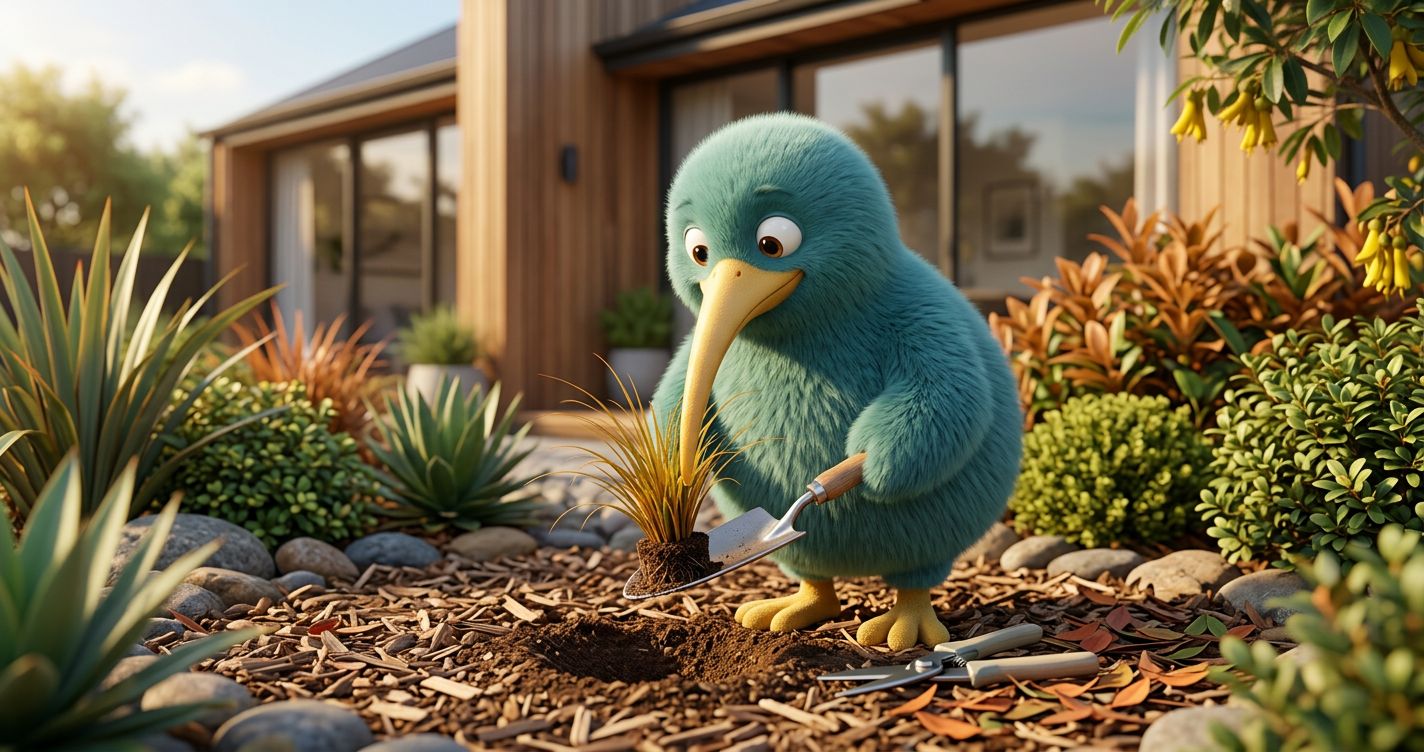
Mulching heavily around new plants helps retain moisture, suppress weeds, and build soil health as the mulch breaks down. Use untreated wood chips, bark, or leaf mulch; avoid fine materials that pack down and repel water.
Most native plants need no fertiliser and may actually perform worse with high-nitrogen feeds that promote soft, pest-prone growth. If you want to give plants a boost, a light application of slow-release native plant fertiliser in spring is sufficient.
Attracting Wildlife
One of the most rewarding aspects of native gardening is watching your garden come alive with birds, bees, and butterflies. Native insects have co-evolved with native plants and depend on them for survival. Introduce those plants, and the insects follow. The birds then come for the insects and the nectar.
Kowhai, flax, and tree fuchsia are particularly valuable for nectar-feeding birds like tui and bellbird. Coprosmas and pittosporums produce berries that kereru love. Tree ferns provide nesting material for fantails. Every native plant you add creates another link in the food web.
Beyond the wildlife benefit, there is something deeply satisfying about a garden that connects to the broader New Zealand ecosystem. You are not just maintaining a collection of decorative plants; you are contributing to something larger, providing habitat, food, and refuge for species that have nowhere else to go as wild areas shrink.